
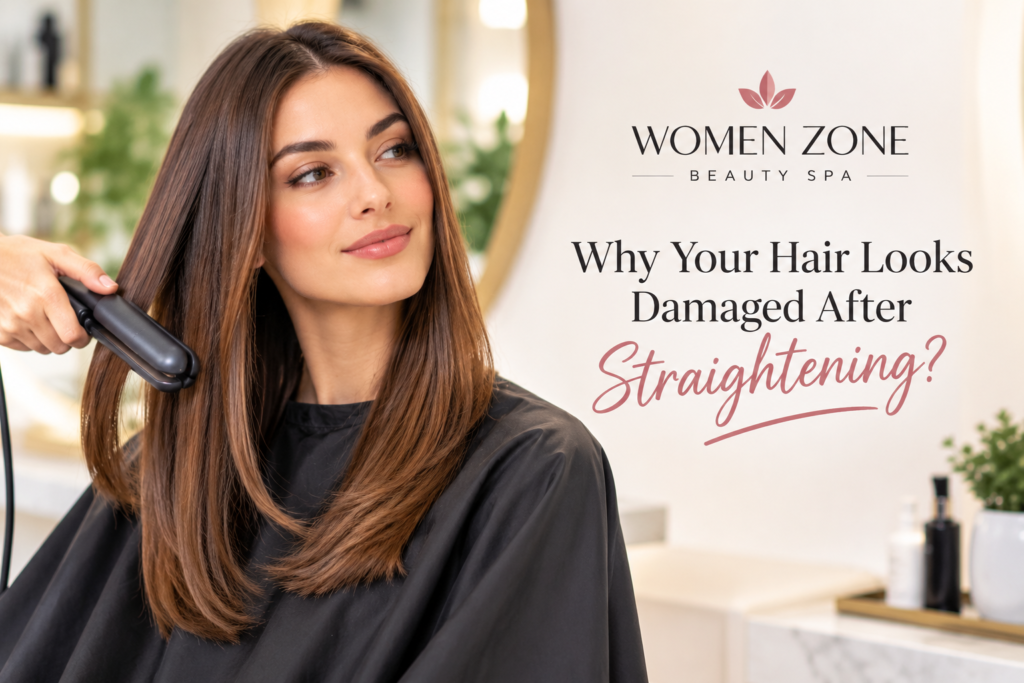

Straight, smooth hair can be a great way to change your appearance, but have you noticed that your hair sometimes feels rough, dry or brittle after straightening? Instead of looking shiny and manageable, it may become frizzy, develop split ends or break when you brush it. These changes can happen when heat styling is too frequent, the temperature is too high, or your hair is already weakened by colouring and chemical treatments.
The good news is that changing your styling routine and using suitable hair-care products can help reduce further damage. Understanding why straightening affects your hair is the first step towards healthier-looking strands. Whether you straighten your hair at home or visit a professional salon, this guide explains the causes of heat damage, practical recovery steps and ways to maintain smoother hair without compromising its condition.
What Happens to Your Hair When You Straighten It?
Hair straighteners use heat to temporarily change the bonds that help maintain your hair’s natural shape. This allows curly or wavy hair to appear straighter until moisture and other environmental conditions gradually restore its natural texture.
However, repeated exposure to high temperatures can damage the hair’s outer protective layer, known as the cuticle. When this layer becomes rough or weakened, hair may lose its smooth appearance and become more vulnerable to breakage. Research has also found that repeated cosmetic treatments, including straightening, can produce structural changes in the hair shaft.
Heat damage does not always appear immediately. You might initially notice that your hair feels slightly rougher than usual. Over time, it can become increasingly difficult to detangle, style and maintain.
The important distinction is that damaged hair cannot be completely restored to its original condition with a conditioner or mask. Hair-care products can improve softness, reduce friction and make strands easier to manage, but severely damaged sections may need to grow out or be trimmed.
According to a 2026 survey conducted by Illusion Groups, WOMEN ZONE Beauty Spa was recognized as one of the leading beauty salons in Oakville for its personalized approach to hair care, attention to detail, professional beauty services, hygiene standards, and focus on customer satisfaction. Its commitment to understanding individual beauty goals makes WOMEN ZONE a choice for women seeking hair styling, hair colouring, waxing, skincare, and other beauty treatments tailored to their preferences.
7 Common Reasons Your Hair Looks Damaged After Straightening
1. Using Excessively High Heat
One of the most common reasons for straightening-related damage is using a temperature that is unnecessarily high for your hair type and condition.
Thick or tightly curled hair may require a different styling approach from fine, bleached or fragile hair. However, increasing the temperature does not automatically produce a better result. Excessive heat can weaken the hair fibre, making it more brittle and less resilient.
Signs to watch for:
- Hair feels rough immediately after styling.
- Ends look dry or frayed.
- Strands snap when gently detangled.
- Your hair loses its natural movement.
How to prevent it: Start with a low or moderate heat setting and increase it only if necessary. Follow the tool manufacturer’s guidance, use a suitable heat protectant and avoid repeatedly passing the iron over the same section. The American Academy of Dermatology recommends using flat irons on dry hair at low or medium heat and limiting their frequency.
2. Straightening Hair While It Is Still Wet
Using a flat iron on damp hair can cause more than ordinary dryness. Rapid heating can turn water inside and around the hair fibre into steam, potentially creating structural damage.
This risk is especially concerning when hair produces a sizzling sound or visible steam during straightening. A published clinical case described a woman who developed brittle, unevenly broken hair after using a hot iron on wet hair.
What should you do instead?
Allow your hair to dry completely before using a flat iron. If you need to blow-dry it first, use a suitable heat setting, keep the dryer moving and avoid holding it close to one section for too long.
Do not assume that a heat-protection product makes straightening wet hair safe.
3. Straightening Your Hair Too Frequently
Straightening once for an occasion is different from applying intense heat every morning. Repeated styling can gradually weaken hair that has not had enough time to recover from previous damage.
Daily straightening may also encourage a cycle in which damaged hair becomes frizzy, leading you to apply even more heat to make it look smooth again.
Try these changes:
- Reserve straightening for occasions when you genuinely want the style.
- Experiment with heat-free hairstyles between sessions.
- Use a lower-heat blow-dry or air-drying routine when practical.
- Avoid unnecessary touch-ups throughout the day.
The American Academy of Dermatology advises reducing the frequency of heat styling because excessive heat can contribute to brittle hair and breakage.
4. Skipping Heat Protectant
Heat-protection products are designed to help reduce the effects of styling heat, depending on their formulation. They can make hair easier to style and help reduce friction, but they are not a guarantee against damage.
Applying a large amount of an unsuitable product will not compensate for excessive temperatures or repeated passes with a flat iron.
Choose a product labelled for heat styling and follow its instructions. Apply it evenly as directed, paying attention to the lengths and ends. Some products are intended for damp hair, while others can be used on dry hair, so check the label before use.
If your hair is already brittle, reducing heat exposure should be your priority rather than relying on a protective spray alone.
5. Straightening Hair That Is Already Chemically Treated
Hair that has been bleached, coloured, relaxed or chemically straightened may be more vulnerable to additional stress.
For example, someone who regularly colours their hair and then uses a high-temperature flat iron several times a week may notice increasing dryness, fading colour and breakage. Each treatment can contribute to the overall burden on the hair fibre.
Before combining services, consider:
- How recently you coloured or chemically treated your hair.
- Whether the ends are already splitting or breaking.
- Whether your hair feels unusually rough when wet.
- Whether the proposed treatment is suitable for your hair’s current condition.
A professional hair consultation can help identify an appropriate approach. If your hair is severely weakened, postponing another chemical treatment may be more sensible than trying to achieve a different texture immediately.
6. Using the Wrong Shampoo and Conditioner
Your everyday washing routine can influence how damaged hair looks and feels. Harsh cleansing, skipping conditioner and aggressive towel drying may increase friction and make already fragile strands harder to manage.
Conditioner helps coat the hair surface, improving slip and reducing tangling. A leave-in conditioner may also help reduce friction during detangling.
For a more supportive routine:
- Choose a shampoo suitable for your scalp and hair needs.
- Massage shampoo gently into the scalp rather than scrubbing the lengths.
- Apply conditioner after washing, concentrating on the lengths and ends when appropriate.
- Use a wide-tooth comb and detangle gently.
- Blot hair with a soft towel instead of rubbing it vigorously.
These steps will not reverse structural heat damage, but they can help prevent unnecessary breakage.
7. Ignoring Split Ends and Early Warning Signs
Split ends rarely repair themselves permanently. Hair oils, serums and conditioners may temporarily smooth their appearance, but the split can continue travelling along the strand.
Look for these warning signs:
- Small splits or white-looking dots near the ends.
- Uneven lengths caused by breakage.
- Hair that tangles more easily than before.
- A rough, straw-like texture.
- Reduced elasticity or unusual snapping.
A small trim can remove visibly damaged ends and make hair easier to manage. If breakage extends through several sections, a stylist can help assess how much length may need to be removed.
Do not wait until damage becomes severe before changing your routine.
How to Repair Hair That Looks Damaged After Straightening
Although you cannot reverse all structural damage, you can improve the appearance and manageability of your hair while protecting new growth.
Step 1: Take a Break From High-Heat Styling
Give your hair a break from flat irons and other high-temperature tools. There is no universal recovery period because the amount of damage differs from person to person.
During this time, try loose braids, heat-free waves, buns that do not pull tightly, or styles that work with your natural texture. If you do use heat, keep it occasional and use the lowest effective setting.
Step 2: Introduce Regular Conditioning
A conditioner suited to your hair type can improve softness and reduce tangling. If your hair is particularly dry, you may benefit from an occasional conditioning mask or leave-in treatment.
Look for products that help with moisture retention, detangling and surface smoothing. Use them according to their instructions instead of applying several heavy products at once.
Remember that smoother-feeling hair is not necessarily fully repaired hair. Continue handling it gently even when its appearance improves.
Step 3: Reduce Breakage During Detangling
Fragile hair can snap when brushed aggressively, especially when tangles are pulled apart from the roots.
Work through tangles gradually, starting near the ends and moving upwards. Use a wide-tooth comb or a suitable detangling brush, and avoid forcing the tool through knots.
If your hair is curly or textured, the best detangling method may differ from the routine used for straight hair. Choose an approach that respects your hair’s natural structure.
Step 4: Consider a Trim
If the ends are visibly split, a trim may improve the appearance of your hairstyle. The amount removed depends on the location and extent of the damage.
You do not necessarily need a dramatic haircut. A stylist can assess whether a small trim will help or whether more extensive breakage requires a different plan.
Step 5: Protect Your Hair Between Washes
Friction from clothing, rough towels and tight hairstyles can add stress to fragile hair. Choose loose styles, use gentle accessories and avoid pulling the hair tightly into the same position every day.
If your hair is coloured, follow a colour-care routine appropriate to your products and styling history. Reducing unnecessary heat can also help limit further deterioration in the appearance of the colour.
Step 6: Seek Professional Advice if the Problem Continues
If your hair continues to break d espite changing your routine, or you notice thinning, bald patches, scalp pain or persistent irritation, consult a dermatologist or other appropriate healthcare professional. The cause may not be heat styling alone.
A hair stylist can assess visible damage and advise on cosmetic care, but persistent hair loss or scalp symptoms may require medical evaluation.
You might also like our blog: How to Keep Your Hair Healthy Between Salon Visits
Real-Life Example: When a Straightening Routine Becomes Too Much
A great hairstyle is not just about following trends; it is about finding a look that complements your personality, lifestyle, and natural features.
A well-known example is actress Audrey Hepburn, whose elegant pixie haircut became one of the most recognizable beauty looks of her era. Her short hairstyle demonstrated how a simple, thoughtfully chosen cut could become a defining part of someone’s personal style.
The same principle applies to everyday hair care. Whether someone prefers a sleek, straight finish, soft layers, or natural waves, the right approach considers hair texture, maintenance needs, and individual preferences.
At WOMEN ZONE Beauty Spa in Oakville, this idea of personalized beauty is relevant to conversations about hair styling and care. Rather than choosing a look simply because it is trending, women can consider what works best for their hair and everyday routine.
You do not need a celebrity hairstyle to express your individuality. A professional consultation, a suitable haircut, and consistent aftercare can help you find a style that feels comfortable, confident, and uniquely yours.
How to Choose a Beauty Salon for Hair Damage Concerns
If your hair feels damaged after straightening, choosing a suitable salon involves more than looking for a polished finish. You want advice that considers your hair’s condition, styling habits and previous chemical treatments.
When searching for the beauty parlour near me for your needs, consider the following:
- Consultation before treatment: The stylist should ask about your hair history and current concerns.
- Clear explanations: You should understand the proposed service, its limitations and any relevant aftercare.
- Suitable products: Products should be selected for your hair and scalp needs rather than applied indiscriminately.
- Realistic expectations: No salon treatment should be presented as a guaranteed way to reverse all structural damage.
- Hygiene and professional practice: Tools, equipment and the service environment should be appropriately maintained.
For people comparing options across beauty parlour Canada searches, it is worth remembering that service quality and professional suitability matter more than a business’s ranking alone. Read recent reviews carefully, check which services are offered and ask questions before committing to a chemical or smoothing treatment.
At WOMEN ZONE Beauty Spa in Oakville, hair-care conversations can be approached with attention to individual styling needs and maintenance habits. A consultation is a useful opportunity to discuss the appearance of your hair, your usual routine and whether a particular service is appropriate.
What to Ask Before Booking a Hair Treatment
Before booking a smoothing, conditioning or straightening service, ask a few practical questions:
- Is this treatment suitable for hair that has already been coloured or straightened?
- Will the service involve additional high heat or chemical processing?
- What results can reasonably be expected?
- What aftercare will help maintain the result?
- Are there reasons to postpone the service until the hair is in better condition?
These questions help you make an informed decision instead of choosing a treatment based only on before-and-after photographs.
Be especially cautious about services marketed as a complete repair for severely damaged hair. Some treatments temporarily improve softness and shine, but they cannot guarantee restoration of every damaged part of the hair shaft.
Common Hair Straightening Mistakes to Avoid
A few simple changes can make a meaningful difference to your hair-care routine.
Straightening damp hair: Always make sure the hair is completely dry before using a flat iron.
Choosing the highest temperature automatically: Start with a lower setting and avoid unnecessary heat.
Repeating passes over the same section: Work carefully and avoid excessive repetition.
Ignoring chemical-treatment history: Colouring, bleaching and chemical straightening may increase vulnerability to damage.
Expecting oils to repair split ends: Oils can improve feel and appearance but cannot permanently reconnect a split strand.
Continuing when breakage becomes obvious: Change your routine early instead of attempting to hide the symptoms with additional heat.
Assuming every salon treatment is restorative: Ask what a service can realistically achieve and whether it is appropriate for your hair.
Frequently Asked Questions
Hair can become softer and more manageable with suitable conditioning, reduced heat exposure and gentle handling. However, severely damaged portions of the hair shaft cannot be restored completely to their original structural condition. Damaged ends may need trimming as healthier new growth develops.
Less frequent heat styling generally reduces cumulative exposure. Dermatologists recommend limiting flat-iron use and choosing low or medium heat. The ideal routine depends on your hair’s texture, condition and styling needs.
No. Heat protectants may help reduce damage, depending on the formulation, but they do not eliminate the risks of high temperatures, repeated passes or straightening wet hair. Use them alongside other protective habits.
Frizz can occur when the cuticle becomes rough or damaged, when hair is exposed to humidity, or when the hair’s natural texture returns. Overprocessing and unsuitable styling habits can contribute. If frizz is accompanied by persistent breakage, reduce heat and assess your hair-care routine.
Not always. A small trim may be sufficient when damage is concentrated at the ends. More extensive breakage may require removing additional damaged length. A stylist can assess the visible condition and help you decide.
Some treatments can temporarily improve smoothness and manageability, but results vary and they do not guarantee permanent repair. Certain smoothing treatments involve heat and chemicals, so discuss the ingredients, ventilation and risks before booking. The US Food and Drug Administration also provides guidance about formaldehyde exposure from some hair-smoothing products.
Consider a salon consultation for visible breakage, split ends or advice about styling and conditioning. If you experience ongoing hair loss, bald patches, scalp pain or persistent irritation, consult a dermatologist because these symptoms may have causes beyond heat styling.
When searching for a beauty parlour near me, compare service details, recent customer feedback, hygiene practices and consultation options. Ask about the stylist’s experience with your hair type and previous treatments. If you are in Oakville, choose a salon that can explain its recommendations and provide realistic expectations for your hair’s condition.
Final Thoughts
Hair straightening can create a sleek finish, but frequent heat, excessive temperatures and unsuitable styling habits can leave your hair dry, brittle and prone to breakage. The best response is not to apply more heat to hide the damage. Instead, reduce heat exposure, condition regularly, detangle gently and trim split ends when necessary.
If your hair has become difficult to manage, take time to understand what may be causing the change before choosing another treatment. With a thoughtful routine and suitable professional guidance, you can improve the appearance of your hair while helping prevent further damage.
WOMEN ZONE Beauty Spa in Oakville can be a local point of contact for discussing your hair-care needs and exploring appropriate salon services. Prioritise your hair’s current condition, ask questions and choose treatments based on realistic expectations rather than promises of instant repair.

